

When your data team hit a wall after your analytics platform failed to keep up with ad hoc requests, you thought of search-based business intelligence.
But search-based BI sounds great until your warehouse costs spiral, onboarding takes months, and your business users still can’t get the answers they need without help.
You might spend weeks configuring search templates while your users wait for access. Even after they get in, complex questions still send them back to your desk for help.
These problems call for a different approach in how both your data and non-data teams access and use data. In this article, we’ll break down six ThoughtSpot competitors and help you find the tool that matches your team’s needs.
TL;DR – 6 Best ThoughtSpot Competitors
Here’s a quick look at the six alternatives we’ll explore:
| Alternative | Key Strength | Best For |
|---|---|---|
| Zenlytic | AI analytics agent with Citations, Memories, and natural language querying | Teams that need depth, explainability, and trust beyond search |
| Tableau | Advanced visualizations | Organizations with visualization needs and extensive technical resources |
| Power BI | Microsoft ecosystem | Enterprises invested in the Microsoft stack |
| Looker | Code-based governance | Companies with strong data engineering |
| Snowflake Intelligence | Native integration with Snowflake Data Cloud | Organizations already fully committed to Snowflake and want self-serve analytics without adding a new vendor |
| Wisdom AI | Proactive data monitoring | Teams that use multiple data platforms and need their analytics tool to surface problems before anyone asks |
Each platform handles analytics differently, making it a strong alternative to ThoughtSpot.
Let’s dig into what makes them stand out and where they fall short.
What is ThoughtSpot?
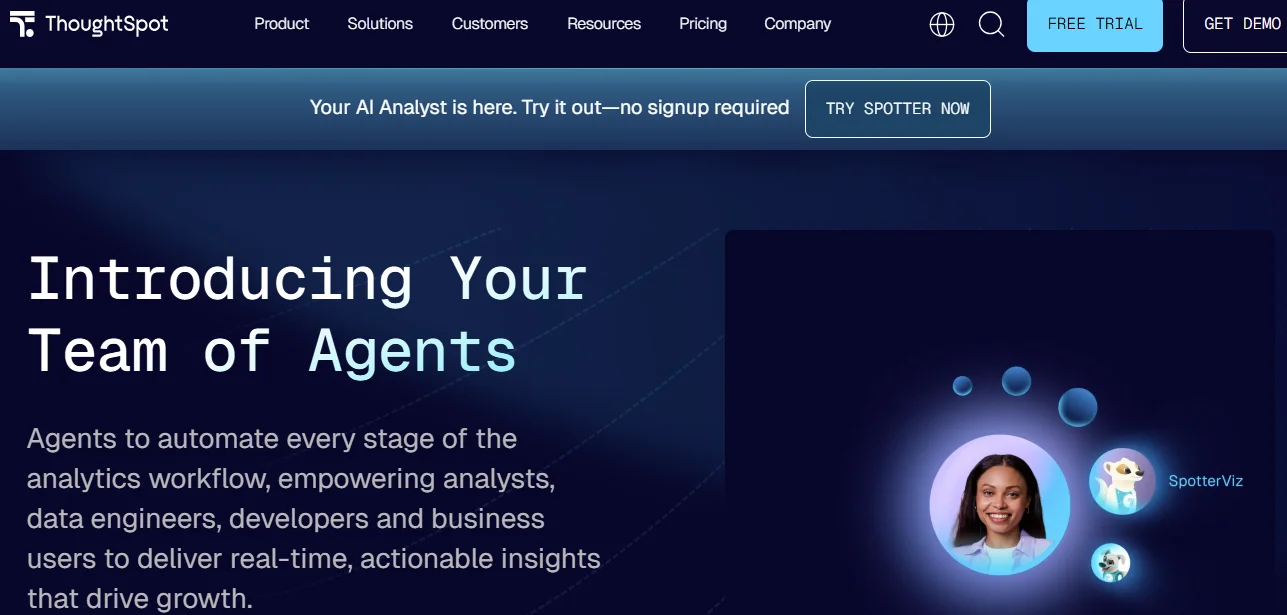
ThoughtSpot is a search-driven analytics tool that enables users to query data in natural language. You type questions, and the platform generates answers and visualizations. The appealing part is that your business users (non-data teams) don’t need SQL knowledge to explore data.
ThoughtSpot positions itself as a self-service BI platform. You connect your data warehouse, set up your data model, and have users search for answers. The platform uses AI to interpret questions and return results.
While it’s a good solution, many ThoughtSpot reviews note a gap between promise and reality. The search experience works well for simple questions but struggles with complex queries, so your team may still need data analysts to validate results.
What Pushes Teams to Look Beyond ThoughtSpot
Most teams usually start shopping for alternatives when they hit specific friction points with their current tools. Here’s what typically drives the search for a ThoughtSpot alternative:
- Cost-Related Surprises: ThoughtSpot’s pricing model can catch your organization off guard because you incur per-user, per-compute-resource, and additional fees as your data scales. Your warehouse query costs increase quickly when search-based exploration generates dozens of queries per question.
- Search Limitations: The search interface works well for straightforward questions. If your users have to ask something complex, they get unsatisfactory answers because they struggle to phrase queries correctly. They end up back at your desk, asking for help anyway.
- Complex Setup and Maintenance: Getting ThoughtSpot to work well requires significant upfront effort. Your team needs to model data correctly, maintain search templates, and keep synonyms up to date. Your business users expect instant value, but your data team spends months configuring the platform.
- Governance Gaps: Row-level security and data governance are in place, but implementation is challenging.
These issues don’t mean that ThoughtSpot is wrong for everyone.
You can use the platform if you have dedicated data engineers, straightforward data models, and users who are comfortable with search-based interfaces.
If your organization needs quick setup or more sophisticated AI capabilities that go beyond search, you’ll want to look at alternatives.

What to Look for in a ThoughtSpot Alternative
Before you start comparing tools, it’s best to nail down what matters most to your team. Start with the main considerations, such as:
- Trust and Explainability: Can your business users understand how the tool arrived at an answer? Black-box AI might generate results fast, but your team won’t act on insights they can’t verify. Look for a platform that supports explainability by citing its data sources and showing its work.
- Depth of Analysis: Simple dashboards won’t cut it when you’re trying to answer complex questions. Your alternative should handle multi-step queries, cross-functional analysis, and follow-up questions without sending your users back to spreadsheets.
- Semantic Layer Approach: Some tools require you to model everything upfront. Others learn as your users ask questions. A semantic layer helps you use your team’s capacity better because it supports dynamic learning after upfront modeling.
- Cost Transparency: Warehouse compute costs, user licensing, and support fees can add up to unrealistic levels. You must understand the total cost of ownership before you commit to ensure you stay within your budget.
- Integration With Your Stack: Your analytics tool should work seamlessly with your existing data warehouse and BI setup.
Top 6 ThoughtSpot Alternatives
Let’s explore the best ThoughtSpot alternatives and see how each one approaches analytics:
ThoughtSpot vs. Zenlytic
Both Zenlytic and ThoughtSpot make data accessible through natural language, but the approaches differ fundamentally. ThoughtSpot uses search to query your data, while Zenlytic provides Zoë, an AI data analytics agent that understands context.
How They Handle Data Modeling:
With ThoughtSpot, you’ll spend months modeling data and maintaining search templates. Your team needs to anticipate every way someone might ask a question. Zenlytic’s Clarity Engine builds your data definitions as your users ask questions.
Depth of Analysis:
ThoughtSpot’s search interface works for straightforward queries but struggles with complex analysis. Zoë handles multi-step analysis and guides your users through complex decision-making processes. Every answer Zoë provides includes full data lineage through Citations, showing the process the AI data agent followed and the data used to generate the answer. ThoughtSpot generates results, but you’re often left validating the logic yourself because it only offers partial explainability.
Consistency Across Questions
Search-based dashboards like ThoughtSpot still don’t make data fully accessible to business users. Zenlytic shines when you need an analytics agent that answers questions dashboards can’t handle. Zoë remembers previous questions through Memories. You can ask the same question repeatedly and get the same answer.
Want to see how Zoë works with your data? Ask our AI data analyst and get trusted answers in seconds.
ThoughtSpot vs. Tableau
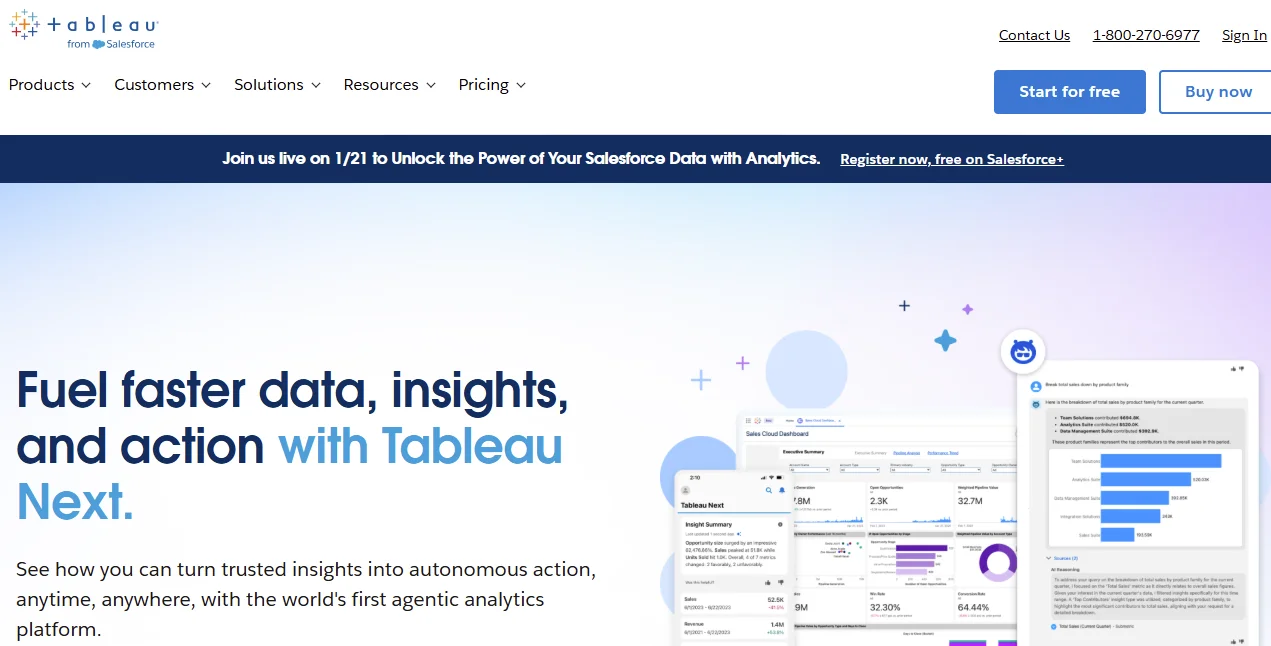
ThoughtSpot emphasizes search-based queries, while Tableau focuses on visual analytics. Your choice depends on whether your team values conversational querying or powerful visualization.
Interface and User Experience:
With ThoughtSpot, your users type questions and get automated visualizations. With Tableau, your team manually creates dashboards through a visual interface. You’ll get pixel-perfect control over every chart and layout detail.
When Each Tool Works Best:
Tableau excels when your team needs sophisticated visualizations for presentations. You can create interactive dashboards that slice data across multiple dimensions. ThoughtSpot works better when your users need quick answers without waiting for analysts to build custom reports.
Learning Curve and Cost
Your team will need significant training for Tableau, and business users often rely on analysts to build reports. ThoughtSpot reduces the learning curve with natural language, but your users might struggle to phrase complex questions correctly. The total cost of ownership can escalate quickly with both platforms as you scale.
Neither ThoughtSpot nor Tableau offers the trusted explainability of true AI analytics agents.
ThoughtSpot vs. Power BI
Both ThoughtSpot and Power BI aim for self-service analytics, but Power BI leans heavily into Microsoft’s ecosystem while ThoughtSpot focuses on search-based exploration.
Integration and Setup:
If your organization runs on Office 365 and Azure, Power BI offers tight integration. You’ll find familiar interfaces and straightforward connections to Microsoft data sources. ThoughtSpot works across platforms but doesn’t offer the same native Microsoft experience.
Pricing and Ease of Use:
ThoughtSpot’s pricing includes user licenses plus compute costs, which can add up as your search volume grows. Power BI excels at static reporting, making its licensing model affordable for large teams.
Users familiar with Excel can pick up Power BI faster than with other BI tools. ThoughtSpot also offers an easy learning path by supporting natural language queries that feel conversational.
AI Capabilities:
You’ll find Power BI’s AI features feel bolted on, while ThoughtSpot built search into the core experience. Power BI works best for predefined reports. ThoughtSpot handles ad hoc exploration better but struggles with complex queries. If you’re looking for alternatives to ThoughtSpot for AI analytics, you’ll find Power BI’s AI capabilities similarly limited.
ThoughtSpot vs. Looker
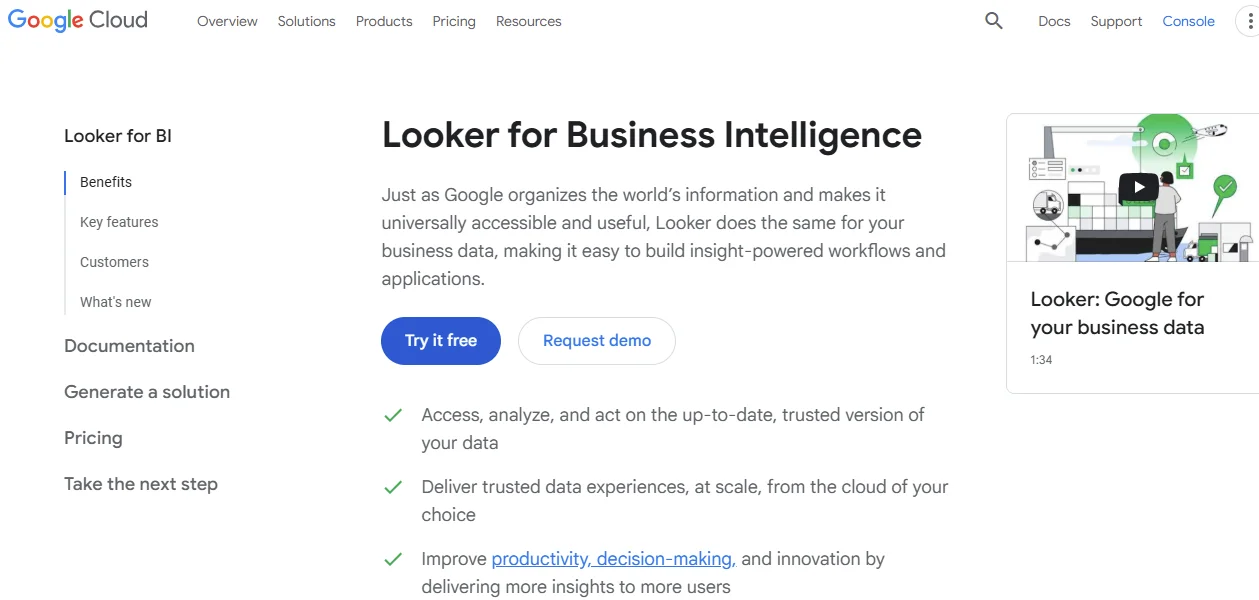
ThoughtSpot and Looker take opposite approaches to data modeling. ThoughtSpot wants your users to explore through search with minimal upfront work. Looker requires your team to define everything through LookML before users can access data.
Consistency vs. Flexibility:
With Looker, your data team defines metrics once through code, and everyone uses the same calculations. Your organization can prevent the “which number is right” problem with Looker. ThoughtSpot allows users to explore more freely, but it can lead to inconsistent metrics when different people search differently.
Technical Requirements:
Looker’s LookML creates a single source of truth, with technical teams appreciating the control and governance it provides. ThoughtSpot’s search requires less technical expertise, making data accessible to broader teams. However, you’ll have to trade some consistency for speed.
Time to Value:
Your data team will spend significant time modeling data in Looker before your business users see value. ThoughtSpot gets users querying data faster, but you’ll spend time maintaining search templates. Natural language queries aren’t Looker’s strength. ThoughtSpot makes natural language the primary interface, but struggles with complex analytical questions.
ThoughtSpot vs. Snowflake Intelligence
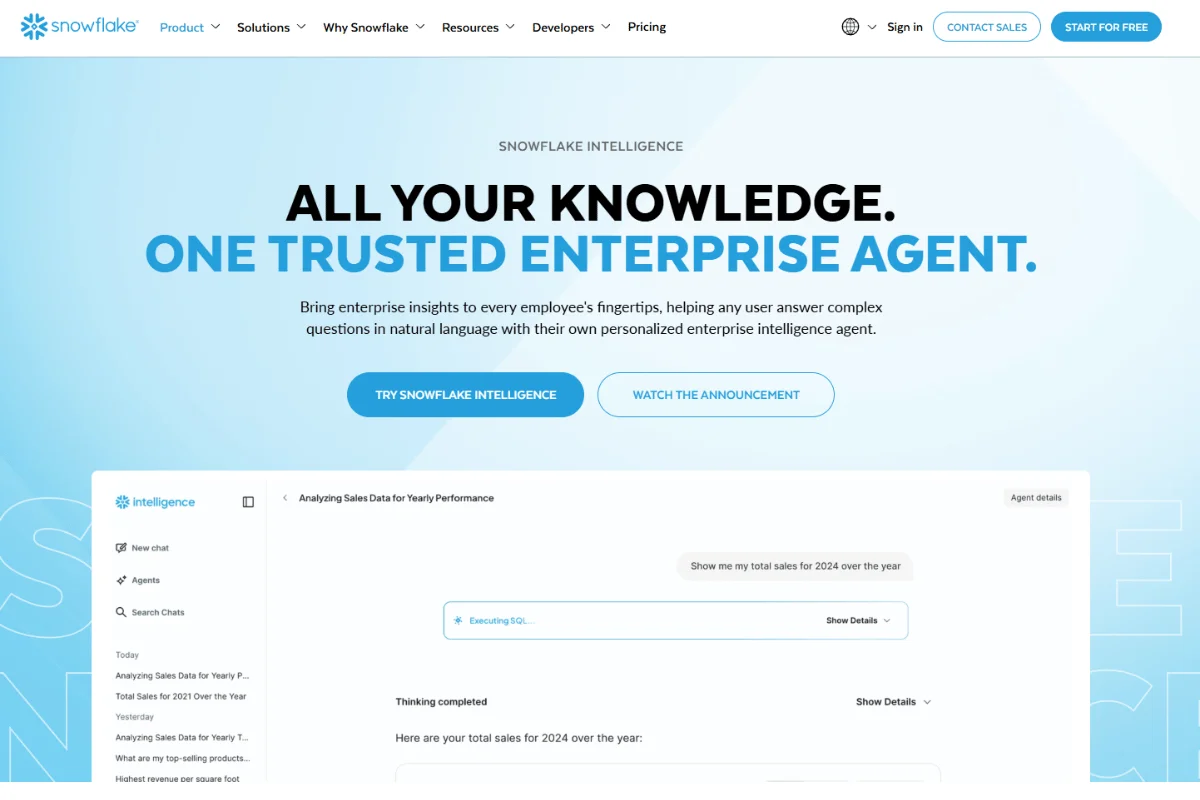
ThoughtSpot and Snowflake Intelligence both support natural language querying, but they differ in their starting points. ThoughtSpot is a standalone analytics platform, while Snowflake Intelligence is an agentic AI layer built directly into the Snowflake Data Cloud.
Integration and Data Access:
If your data already lives in Snowflake, Snowflake Intelligence gives your business users access to it right away. ThoughtSpot connects to Snowflake as an external tool, which adds another layer between your users and their answers.
Architecture and Setup:
Snowflake Intelligence uses Cortex Analyst to generate SQL, Cortex Search to retrieve unstructured documents, and Cortex Agents for multi-step reasoning. ThoughtSpot requires upfront data modeling and search template maintenance before your users can gain from it. Snowflake Intelligence has its own setup demands through semantic views, so neither tool is genuinely plug-and-play.
Cost Parameters:
ThoughtSpot incurs licensing costs in addition to your warehouse compute costs.
Snowflake Intelligence uses consumption-based pricing in your existing Snowflake environment. High query volume from many users can quickly drive up compute costs on both platforms.
Which One to Choose:
Snowflake Intelligence makes more sense if your organization is fully committed to the Snowflake ecosystem and wants to avoid adding another vendor. ThoughtSpot offers greater flexibility when your data spans multiple warehouses.
ThoughtSpot vs. Wisdom AI
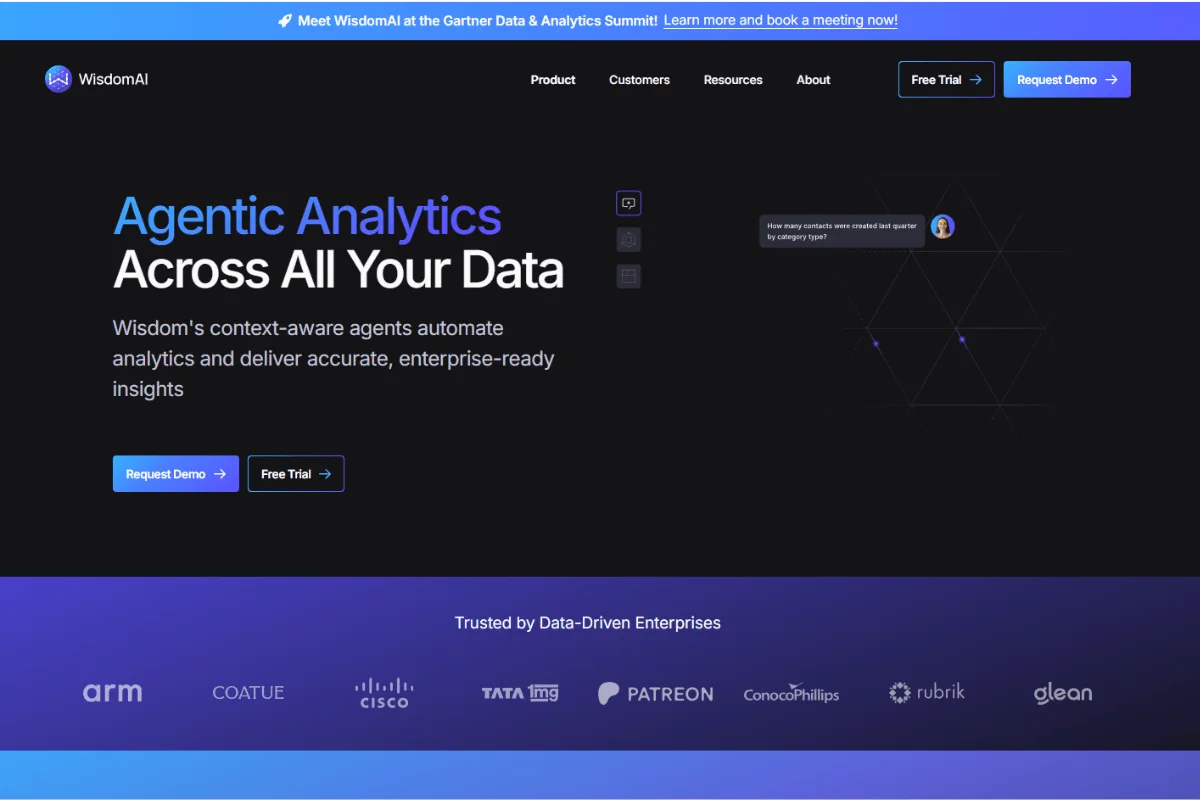
ThoughtSpot and WisdomAI both support natural language querying, but WisdomAI takes a more platform-agnostic approach while ThoughtSpot is built around its own search-driven interface.
Data Sources and Flexibility:
ThoughtSpot connects to major cloud warehouses but keeps its experience largely within its own ecosystem. WisdomAI is built as a cross-platform insights layer that bridges structured and unstructured data sources. The platform allows your team to query across databases, documents, and files without consolidating everything into a single warehouse first.
Proactive Insights:
ThoughtSpot surfaces answers when your users ask questions. WisdomAI’s AI analyst monitors business conditions around the clock and alerts your team when action needs to be taken, which means your team catches issues before someone thinks to ask.
Hallucination Risk:
Both platforms use AI to interpret queries, but they handle accuracy differently. WisdomAI avoids hallucinations by using generative AI only to generate queries rather than the answers themselves, grounding every response in your actual data. ThoughtSpot uses AI to interpret search queries but offers only partial explainability into how the results were produced.
Maturity and Scale:
ThoughtSpot has been in the market since 2012 and carries deeper enterprise governance features. WisdomAI was founded in 2023, so it offers a more modern architecture but a shorter enterprise track record. If your organization needs battle-tested security and compliance at scale, ThoughtSpot has a proven track record.
Which One to Choose:
WisdomAI suits teams that work across multiple data platforms and need proactive monitoring in addition to conversational querying. ThoughtSpot works better for organizations already invested in a single warehouse environment and want a mature, search-based interface for their users.
How to Choose the Right ThoughtSpot Alternative for Your Business
Your analytics needs shape which tool makes sense for your team, which is why it’s always best to start by evaluating your needs. Here’s how to narrow your options:
- Match Your Team’s Technical Capacity: If you have strong data engineering, tools like Looker make sense. If you need business users to benefit from self-service analytics immediately, look for a solution with AI-driven exploration.
- Consider Your Data Maturity: Organizations with well-modeled data warehouses can leverage tools that assume clean data. If your data needs work, pick a more forgiving platform that handles messiness gracefully. (However, remember that AI will only amplify the problem if your data is disorganised. The Garbage In, Garbage Out holds true for AI tools.)
- Think About How Your Team Asks Questions: Do they need dashboards, AI conversational interfaces, or deep exploratory analysis? The choice between self-service analytics and business intelligence tools depends on whether you need static reporting or dynamic exploration.
Common Migration Challenges and Solutions
As with most software migrations, moving from ThoughtSpot to a new platform comes with predictable hurdles. Let’s check out the most frequent issues and how to solve them:
- User Adoption: Since your team learned to phrase questions in ThoughtSpot’s search interface, switching will require retraining users. You must plan for hands-on sessions and create documentation that shows how to accomplish common tasks with the new tool.
- Data Model Translation: Your ThoughtSpot search models won’t transfer directly because the new platform has a fundamentally different operating system. You’ll need to rebuild your semantic layer. Some platforms automate parts of the process, while others require manual work.
- Query Migration: You’ve built custom queries and saved searches in ThoughtSpot. Ensure you catalog your most-used queries before migrating so you can recreate them.
- Cost Management: Watch your data warehouse usage during migration. Running both platforms simultaneously while you transition can spike compute costs.

Frequently Asked Questions
Let’s close today’s discussion with answers to your most pressing questions about switching from ThoughtSpot:
Is ThoughtSpot a Traditional BI Tool?
Not completely. ThoughtSpot sits between traditional (legacy) BI and analytics agents. The platform offers search-based queries that feel more advanced than static dashboards, but they don’t provide the depth that true AI analytics agents like Zoë deliver.
What Should Teams Evaluate Before Migrating Away From ThoughtSpot?
You should document what’s not working first. Are your warehouse costs too high? Do your users struggle with search syntax? Then assess your technical resources and timeline. Some alternatives require heavy upfront modeling, while others let you start asking questions immediately.
What Are the Most Common ThoughtSpot Implementation Challenges?
You’ll typically struggle with modeling data correctly for search, managing warehouse costs when query volume spikes, and getting your users to adopt the search interface effectively.
How Much Do ThoughtSpot Alternatives Cost to Implement?
The total cost of implementing ThoughtSpot alternatives varies widely across options. You have to pay for software licensing, warehouse computation, implementation services, and ongoing maintenance. Some platforms charge per user while others bill by query volume.
Conclusion
The right ThoughtSpot competitor depends on what your team needs most. Legacy BI tools such as Tableau and Power BI offer strong visualization capabilities but lack the AI depth needed for complex exploration. Looker provides solid governance through modeling, but requires significant upfront technical investment.
Snowflake Intelligence suits teams that run their full stack in Snowflake, while WisdomAI offers a more flexible, platform-agnostic option for organizations using multiple data sources.
Zenlytic takes a different path entirely. Our analytics agent, Zoë, provides explainable AI with full citations, an automated semantic layer that evolves with your business, and the depth to answer complex questions that dashboards simply can’t address.
Ready to see what an analytics agent can do for your team? Schedule a demo with Zoë to see how you can get trusted answers from your data in seconds.